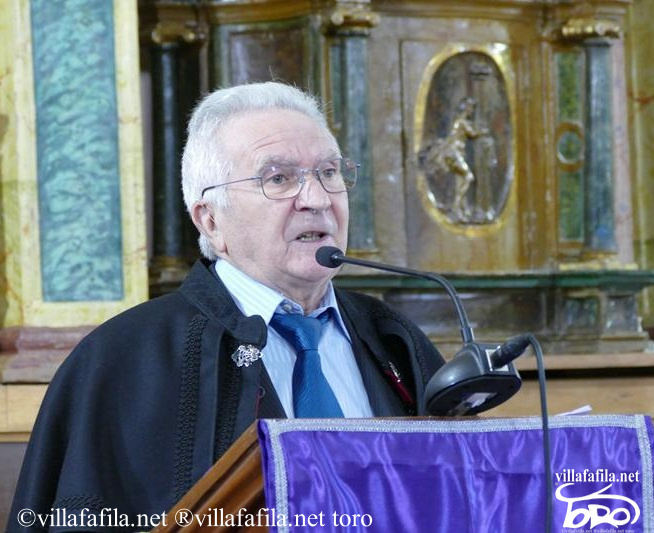
PROCLAMATION - HOLY WEEK - VILLAFÁFILA 2025 - D. AGAPITO GÓMEZ GARCÍA

|
|
PROCLAMATION - HOLY WEEK - VILLAFÁFILA 2025 - D. AGAPITO GÓMEZ GARCÍA |
|
|
|
|
Good afternoon, and a cordial greeting to all of you. On September 29, 2022, I sadly said goodbye to this beloved parish of Our Lady of Moral in Villafáfila after thirty years of service. At that time, the President of the Holy Week Board called me to invite me to deliver the Holy Week Proclamation. Thank you for the invitation, and I am grateful to be with you in this Jubilee Year of Hope, which opened in our diocese on December 29, 2024, in the Cathedral of Zamora. I greet the Mayor of the town, Antonio Jesús Rodríguez, and his municipal council. The Deputy for the Campos area, José Ángel Ruiz, the Authorities, and the Presidents of the various parish brotherhoods. And Father Fernando, your parish priest, who took possession of the parish last September. I wish you a happy coexistence and all the best in your ministerial life for the good of the community you have been sent to serve, following the example of Christ at the Last Supper. Every New Year, when we receive a calendar or buy a diary or a Sacred Heart of Jesus pad, we look and mark the holidays and days that are most dear to each of us: Christmas, Holy Week, Easter. The Assumption, and the local festivals of Los Compadres, Las Comadres, and San Roque. We prepare for, celebrate, and live them with great excitement and joy. The Church also encourages us to prepare for the major celebrations. We prepare for Christmas four weeks in advance. After Christmas, we have two special dates in our town: Compadres and Comadres. Dates of conviviality, gathering with friends, and fun in the peñas. These dates bring us closer to Ash Wednesday, that time of preparation for the Passion, Death, and Resurrection of Our Lord Jesus Christ, the Passover of the Lord. Ash Wednesday introduces us to the season of Lent, forty days of preparation for Easter. The imposition of Ashes on our hips reminds us of who we are and calls us to conversion: convert and believe in the Gospel. This is the message that resonates strongly in our churches every year. And from this day forward, in the parish, a group of faithful recommends, before the celebration of the Eucharist, the fourteen stations of the Way of the Cross. In our church, the songs of Lent and Holy Week are already heard, popular songs we learned in our childhood, along with the penitential Psalms of Miguel Marzano, which I studied during my time as a philosophy student. The musicologist from Zamora, who recently passed away, was a student of this message. Under his direction, the schola cantorum of the seminary, in the Plaza de Viriato, every Holy Thursday evening we sang the Miserere. As the days of the Passion approached, the image of the DOLOROSA was being prepared. This beautiful image is worshipped every year, with its novena and mass on Good Friday. The brotherhood of Our Lady of Sorrows carefully prepares its worship and procession for Good Friday, collaborating in leap years with the Descent of Christ from the Cross. We, accompanying her on her path of sorrow, embrace her maternal love so that she may cover us with her mantle in our moments of difficulty and suffering. We accompany her in her sorrow, the sorrow of a mother who sees her Son misunderstood, harassed, abandoned by the fearful apostles, scourged by the sweaty Romans, crowned with thorns, spat upon, slapped, walking barefoot beneath a heavy tree toward Calvary, where he finally witnessed the agony of his death on the cross, nailed hand and foot. To her we sing: Sorrowful One who art in zeal, send consolation to my plowman. With the consolation and strength of Mary, at this time, the parish community of Villafáfila is invited to reconciliation, to the forgiveness of its sins for a greater and better experience of the mysteries we are about to celebrate. We are on the threshold of the great Holy Week; Palm Sunday. It is the day for thousands of people who are already enjoying their holidays. Family, friends, and acquaintances come to Villafáfila, eager to experience their town's Holy Week and participate in both the liturgical services and the processions. Jesus enters the Holy City riding a donkey, the animal of the simple, common country people, a donkey that does not belong to him, but that he borrows for this occasion. The afternoon of Palm Sunday brings us to the traditional auction of images that will be carried in procession during Holy Week. At 5:30 p.m., after the rosary, the auction begins. Children play and run around the church, and groups of young and old take their positions. A volunteer directs the auction, animatedly bidding among themselves, and the third is awarded. Once the auction is over, a large group of men and women prepare everything necessary: the monument, images, etc.… hard work that they will carry out in the following days, until late into the night. Everything is ready for the liturgical celebrations and processions that begin on Holy Wednesday with the Christ of Mercy, a beautiful sculpture from the parish of San Martin. Villafáfila has a long tradition of Holy Week, as I was informed when I arrived as parish priest, and I must confess that it made a great impression on me and reminded me of my time studying at the major seminary in Zamora. We seminarians celebrated Holy Week in our chapel or in the Church of San Andrés, outside the city's popular piety, which was attended not only by people from nearby towns but also from many other places. We had classes on Monday, Tuesday, and Holy Wednesday, with Easter week as our vacation. On Holy Tuesday, in the evening, the procession of the Brotherhood of Jesus of the Way of the Cross left San Andrés. It currently leaves San Frontis, with Jesus of Nazareth and the Virgin of Hope. And we saw her at the time of the departure. On Holy Thursday, during the procession of Silence, we from the schola cantorum would go to Viriato Square and there, in the center, once all the members of the brotherhood were gathered, we would sing the MISERERE with an impressive and moving silence. On Good Friday afternoon, the Authorities and our diocesan Bishop attended the Holy Burial procession with the seminarians. Many floats were carried in procession, and behind each float, two senior seminarians escorted them. These are my memories of popular religiosity, which in my years as a priest I have tried to deepen, live, and transmit. Villafáfila continues to intensely celebrate its Holy Week, and as early as 1992, a group of young people proposed reviving the procession with the Christ of Mercy. After several meetings, it was agreed to hold the Silent Procession on Holy Wednesday evening with the image of the Most Holy Christ of Mercy and to revive the singing of the Miserere in the Town Hall Square. And so, in 1993, we began the procession. The members of the Brotherhood, wearing their tunics, capes, and hoods, would gather in the parish center, and when the time came, they would march into the church on either side of the image, located in the center. The following song was sung: "Perdona a tu pueblo" (Forgive your people). The priest gave a preparatory reflection, and some verses were read to the Christ of Mercy, composed by Jacinto Fuertes, a native of this town and a lover of Holy Week. Before leaving, the members of the brotherhood were sworn to remain silent as they passed. Today, allow me to recall some verses composed by our beloved and remembered Jacinto:
In the year of his death we apply the Eucharist for his eternal rest. Today I also want to remember all the members of the brotherhood who rest in the peace, love, and mercy of the Lord, and remember that young boy, Alex, who accompanied us year after year with his drum, inviting us to silence and prayer. On September 28, 2024, on the road from Casaseca de las Chanas to Zamora, an unfortunate accident took the life of Alex Martín Ferrero, son of Juli and Pilar, at the age of 21. Let us remember and pray for him, and may the Holy Christ of Mercy reward him for his presence during the years he accompanied us. With our hearts heavy, we walk in silence, only pausing occasionally to allow the bearers to change, and hoping to witness the singing of the Miserere. During one of these changes, a cry of jubilation is heard. Some are watching a derby, a Champions League team, one of the teams scores a goal, and joy reaches the procession, but that joy gives way to the singing of the Miserere in Town Hall Square. An important moment occurs when a choir soloist sings the verse: tibi soli peccavi, tibi soli peccavi et malum coram te fecit. Against You, against You only, have I sinned, I have committed the wickedness that You abhor. The Miserere is the most beloved, sung, and meditated upon penitential psalm. A hymn to the merciful God, raised by the repentant sinner. The message of hope of the Miserere that the Psalter places on the lips of David, a converted sinner, is this: God erases, washes, and cleanses the guilt confessed with a contrite heart. Already in the church, the brotherhood, together with the community, sang the Lover Jesus on Holy Thursday. We were terrified in the EASTER TRIDUUM. We are approaching the central days of Holy Week, in which we commemorate the great mysteries of Jesus' life. The first days belong to Lent, while the last days commemorate, step by step, the final events in the life of Jesus of Nazareth. Good Friday, Saturday, and Easter Sunday liturgically form the so-called EASTER TRIDUUM. Christ's death is not a tragic end, but for his disciples it brings hope in the Resurrection. In the Upper Room, Jesus celebrates the Last Supper with his disciples. He wants to say goodbye to them. He has loved his friends and loves them to the extreme. A dinner is always a cordial way to celebrate a farewell with friends, even if among them there are traitors, cowards, fearful, or inconstant ones. He needs to teach them the final lessons of humility, service, and dedication. He entrusts them with what will be the hallmark of his disciples, by which they will be known as such: If you love one another as I have loved you. And he leaves us the greatest thing that anyone can bequeath: his Body given and his Blood shed for all. The four evangelists complete a detailed account of the dramatic moments of that dense, painful, sad night. A night of betrayal, abandonment, slander, contempt, mockery, and loneliness—above all, loneliness. His friends have disappeared, and even the Father himself seems to ignore him. "Let this cup pass from me," sighed Jesus in Gethsemane. Death is a bitter pill to swallow. But the task of dying is to sip life, sip by sip, and to face, discover, value, and recycle the bitter dregs left behind when this cup is swallowed. Only those who live suffer. Only those who suffer mature, and only those who mature are reborn from their ashes. It is the fruitfulness of suffering that reveals the positive side of life's negative. As a sign of penitence, we accompany the ECCE HOMO in procession. Before the day ends, the Vera Cruz brotherhood carries its Christ in procession, a beautiful image by Víctor Bahía. This is a typically Holy Week brotherhood that originated in the parish of San Andrés. When the parish of San Andrés was abolished, it moved to the parish of San Pedro, continuing its activity in the Hermitage until it ceased to do so around 1880. Mr. Elías Rodríguez, a native of this town, a doctor and historian by vocation, and a lover of the culture of his town, promoted, together with the Junta Pro Semana Santa, the revival of the Vera Cruz brotherhood, which paraded again in 2010. I would like to thank Elías for his research work in the parish archives of his town. Thank you for your excellent work. After the Holy Hour, already at night, the procession begins with a prayer and the Stations of the Cross: tears from the heart / of pure pain let us weep / so that we may all obtain / the fruits of the Passion / the fruits of the Passion. Next to the old cemetery, a station is made, a prayer service is said for all the deceased, and the procession returns to the parish. The Son of Man is delivered into the hands of the powerful. On Good Friday morning, Villafáfila accompanies Jesus of Nazareth, the most beloved and venerated image. The children, excited by the trumpet, blow it, announcing the beginning of the procession. The penitents, in robes and hoods, are already prepared. Jesus of Nazareth is accompanied in the processional parade by Mary and Saint John. After the priest's greeting and reflection, the procession begins with the hymn to Our Father Jesus of Nazareth. A moment of impressive silence, of intimate prayer, of religiosity, of faith, reflected in the faces of the children of Villafáfila. Our Father, Jesus of Nazareth Eternal King of love and peace Always reign over your faithful devotees And on the world, Lord, have mercy Behind the image of Jesus, those who have made an offering begin to gather, some barefoot as a sign of penitence, with the authorities and priest bringing up the rear. Upon reaching the Plaza, the young men carrying the float of Saint John detour to meet Mary and Jesus again. John runs to see Mary, and in the Town Hall Plaza, Mother Mary and the beloved disciple John meet, with Jesus bowing. After the bows, we continue accompanying Jesus, Mary, and John with penitential songs. On the evening of Good Friday, the parish community gathers again for the Holy Offices, the liturgical celebration of the Passion, Death, and Burial of the Lord. Through the evangelist Saint John, we read the impressive account of the Passion of Our Lord Jesus Christ. Our prayer today takes on a more solemn tone, and above all, it aims to be a prayer that reaches out to all, so that the salvation born of the life given by Jesus on the Cross may reach all. The Cross will then be solemnly shown to us. The Cross is the center of our salvation, and we will be invited to look upon it and adore it. In it, we gratefully contemplate Jesus' dedication and complete love for us. Look at the tree of the Cross, where the salvation of the world was nailed, and silently we approach to venerate it. After the celebration we go out in procession with the Urn of the Saint Burial, Las Angustias and the Virgin of Sorrows. In leap years, the Christ of the Urn, articulated, is placed on the cross in the presbytery, on the right, and the Virgin, who bows her head, on the left. The brotherhoods of Christ of Mercy and Our Lady of Sorrows collaborate in her descent. Dolores, at her placement in the Urn. Holy Saturday, Mary in her solitude. Mary's presence could not be missing. She was always at her Son's side. In Jesus' Passion, she appears occupying a prominent place. It could not be otherwise, because no one like her knew how to be at her Son's side in joyful moments and in difficult hours. Discreet and quiet, but faithful to the Master, meditating on his teachings and keeping them in her heart. The Virgin of La Soledad is depicted at the foot of an empty cross, empty of anything. What a lonely day that Saturday before the Resurrection! But Mary's faith, trust, and love took refuge in God's will. Believing, trusting, and loving, she knew how to await the greatest joy of her life: that of recovering her Risen Son forever. The Gospel, it is true, says nothing about Jesus appearing to his mother after his resurrection. It didn't need to say so. He appeared to her first. If they were intimately united from the Incarnation to the cross, they must be so at the Resurrection. And every Holy Saturday, the women of Villafáfila accompany her with affection and love. Before dying, Jesus gave her to us as our Mother. Our Mother is there for all, with her tearful eyes welcoming her son with the same affection she did in Bethlehem as a child. Offering him to all with the same love with which she presented him to the shepherds and wise men. We lovingly accompany her in the procession of La Soledad, praying and singing the Holy Rosary and the Hail Mary. And we arrive at the most important date in the lives of Christians: The Resurrection of Our Lord Jesus Christ, this year, 2025, on April 20th. The Church gathers around a bonfire to await the greatest event imaginable; the one that gives meaning to her life and ensures that the Passion and Death were not a failure; the one that transforms the buried and destroyed seed into the fruit of life. We hear it in the Easter Vigil Proclamation: let the choirs of angels finally rejoice, let the earth also rejoice, flooded with such clarity. This is the night when, the chains of sin broken, Christ ascends victorious from the abyss. Happy is the sin that merited such a Redeemer. Thus, this holy night drives away sins, washes away guilt, restores innocence to the fallen, joy to the sad, expels hatred, brings harmony, subdues the powerful - What we celebrate in these days is Easter, the passage, the death that opens to life, or better, the Life that Christ offers us. Risen after passing through death. In these days it is appropriate to contemplate the Passion in one way or another to enter into the mystery of faith and prepare for the celebration of what is essential, what gives meaning and value to everything else: the Resurrection and Life, love and forgiveness, Jesus Christ Risen, God and Man, love, joy, forgiveness and life. To believe that God raised Jesus through the power of his Spirit is to recognize the absolute priority of everything for which he lived and died. Therefore, at the Easter Vigil, we celebrate that Christ lives and that we live his life. That he has risen and that we will rise with him. The Easter feast creates presence, encounter, recognition, and mission. We rely on the faith of the apostles who come to believe in Jesus Christ crucified and risen: Do not be afraid; it is I. The first and the last, the one who lives. I was dead, but now I am alive forevermore. And we cannot live this without the faith of the believing community, the faith of the Church of yesterday and today. Because the Church is the one who believes that Jesus, the crucified one, lives in the Father and in us. On Easter morning, we witness in the square the encounter of the Mother with the risen Son, the Savior. The Virgin, in her invocation of Carmel, has worn the black mantle, and now it is removed so that she may wear the mantle of joy. Joy that we share, this year. Jubilate pilgrims of hope. Truly believing in the resurrection of Christ should transform us into men and women who bear and communicate hope in a world lacking it. May the resurrection of Christ commit us to always be leaven and bearers of hope in our world. Let us accompany Christ crucified in his Passion and Death. Let us accompany the Risen Christ in his joy and happiness. May he reward us all. Once again I wish you a happy Holy Week and a better Easter.
Agapito Gómez García. Holy Week Proclamation 2025. Villafáfila April 13, 2025. Author: José Luis Domínguez Martínez. ©villafafila.net ®villafafila.net bull
Text: Agapito Gómez García. Town crier of Holy Week in Villafáfila 2025.
Photograph: José Luis Domínguez Martínez.
Transcription, assembly and layout: José Luis Domínguez Martínez.
All text, photographs, lithographs, transcription, assembly and layout are copyrighted by their authors. Any unauthorized use is prohibited.
All text, photography and lithographs have been authorized for storage, processing, work, transcription, assembly and layout to José Luis Domínguez Martínez, its dissemination in ©villafafila.net ®villafafila.net toro, and any other means that the authorized one deems appropriate. |